
Rightsizing the Right Way
The PPS School Board is currently identifying up to twenty schools in the district that will be closed as of the 2027-28 school year. This process, called rightsizing. The district asserts that rightsizing is necessary due to declining enrollment. As they continue to make decisions for potential school closures, we are worried the potential impact will predominantly fall on schools with a higher proportion of historically marginalized students.
Rightsizing the Right Way is a campaign formed by parents from PPS neighborhood schools to draw attention to the importance of keeping neighborhood schools intact and shed light on the harm caused by disinvestment in these communities over the past decades.
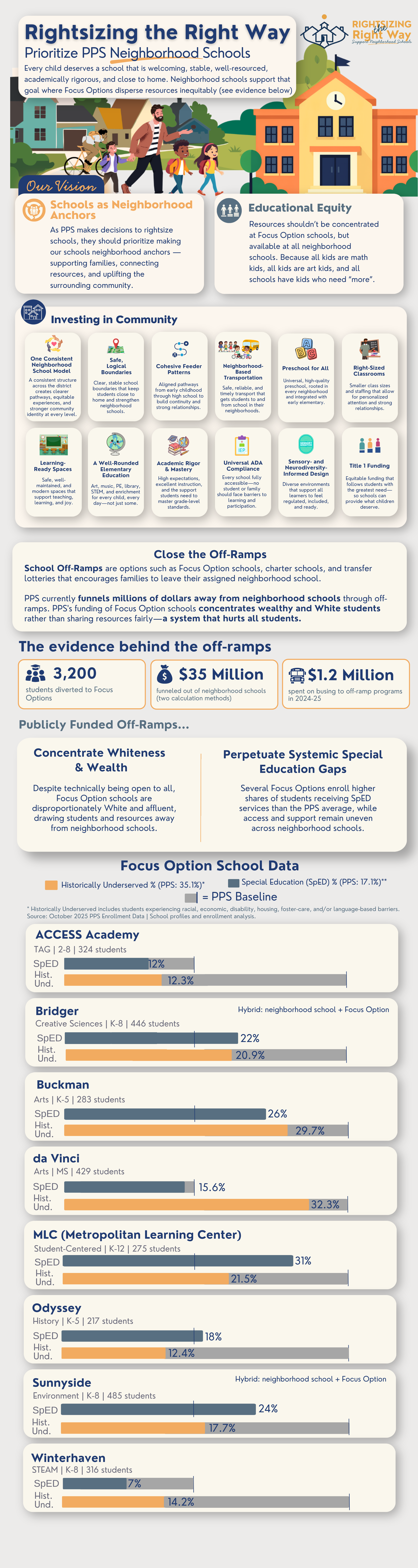
The current system funnels millions of public dollars away from neighborhood schools into specialized programs known as Focus Option schools that concentrate resources and privilege. In 2025-26, 3,200 students opted out of their neighborhood schools for Focus Option schools and as a result ~$35 million was redirected away from neighborhood classrooms.
Help us urge the school board to prioritize neighborhood school funding as they consider consolidation and school closing by signing this petition.
We’ve gotten some concerns that this campaign is too divisive, pitting parents and schools against parents and schools rather than directing our efforts to the sources of the challenges: PPS and state funding.
We agree it’s a tough topic, but one that’s worth talking about and we also believe we can advocate for better management of resources within the district while also advocating at the state level.
Our answer to the question about divisiveness is this: Our schools are already competing with one another. Neighborhood schools lose enrollment when families leave for focus options and charters, and enrollment directly affects staffing and resources. Then those same neighborhood schools that people leave are labeled as “under-enrolled” or “underutilized” and placed at risk of closure.
Rightsizing the Right Way did not create that competition. PPS did, through a structure that asks neighborhood schools to compete for students while actively providing district-supported alternatives. We as neighborhood-school advocates are being accused of creating division simply for pointing this out. If folks want to be angry, that's understandable, but direct that energy at the district and at the state.
The goal is not to take a good educational experience away from one group of children, but to ask why families feel they have to leave their neighborhood school to get that experience. If Focus Options are so attractive because they offer strong specialized programming, then the answer should be to make those opportunities available in neighborhood schools too.
It’s actually really simple: Make all neighborhood schools places families want to choose.
How Dollars Are Taken Away from Neighborhood Schools
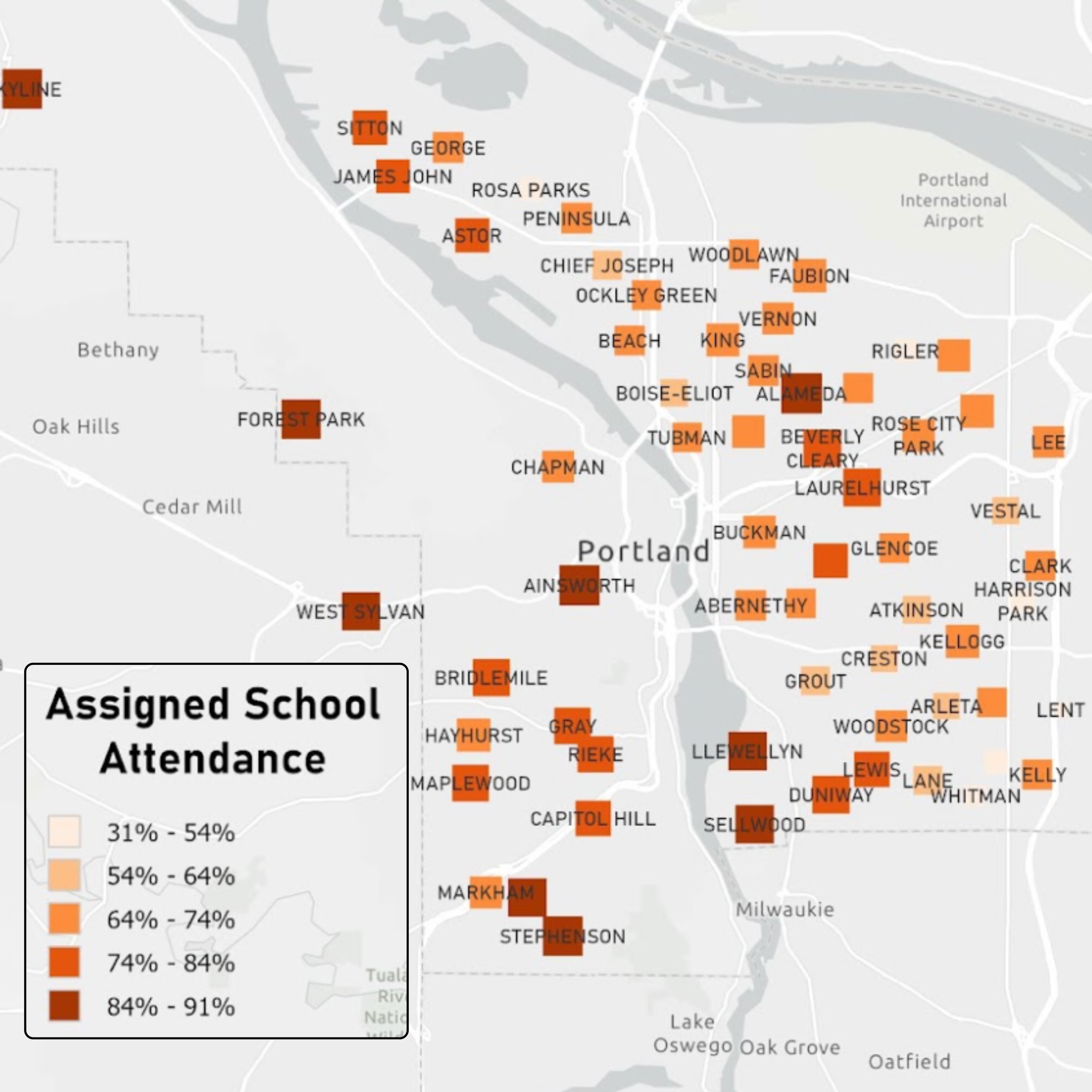
This map created from PPS enrollment data shows how neighborhood schools are impacted by publicly funded off-ramps.
What full investment in neighborhood schools could look like
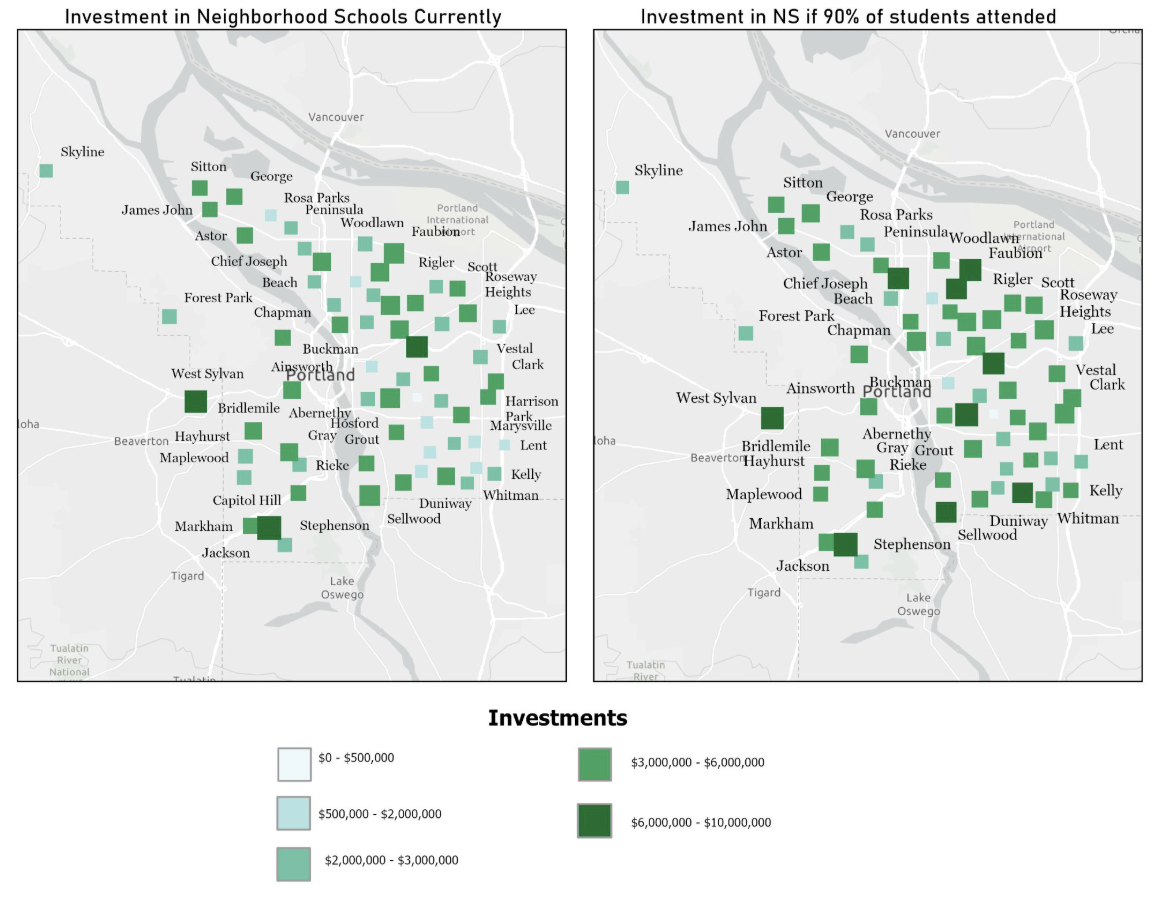
Lack of investment in neighborhood schools (LEFT) vs. full investment in neighborhood schools (RIGHT)--DARK GREEN IS GOOD!
Frequently Asked Questions
-
We are a group of concerned parents working to hold the district accountable for past decisions that have exacerbated segregation and disinvested in neighborhood schools.
Our goal is to support neighborhood schools and challenge school choice. We are not necessarily advocating for our individual schools. Rather, we share a vision of a more equitable distribution of resources within PPS.
We are Elizabeth Doerr a parent from Faubion, Hannah Love a parent from Vernon, Michelle DuBarry a parent from Ockley Green, Kevin Richoux a grandparent of Faubion students, and other parents representing students from Faubion, Woodmere, Sabin, and Grant. We also have a petition with over 200 signatures and growing from parents who also believe in protecting neighborhood schools. If you have any questions, we’re happy to chat with you. So just reach out to us in the form below. Thanks!
-
We’ve gotten some concerns that this campaign is too divisive, pitting parents and schools against parents and schools rather than directing our efforts to the sources of the challenges: PPS and state funding.
We agree it’s a tough topic, but one that’s worth talking about and we also believe we can advocate for better management of resources within the district while also advocating at the state level.
Our answer to the question about divisiveness is this: Our schools are already competing with one another. Neighborhood schools lose enrollment when families leave for focus options and charters, and enrollment directly affects staffing and resources. Then those same neighborhood schools that people leave are labeled as “under-enrolled” or “underutilized” and placed at risk of closure.
Rightsizing the Right Way did not create that competition. PPS did, through a structure that asks neighborhood schools to compete for students while actively providing district-supported alternatives. We as neighborhood-school advocates are being accused of creating division simply for pointing this out. If folks want to be angry, that's understandable, but direct that energy at the district and at the state.
The goal is not to take a good educational experience away from one group of children, but to ask why families feel they have to leave their neighborhood school to get that experience. If Focus Options are so attractive because they offer strong specialized programming, then the answer should be to make those opportunities available in neighborhood schools too.
It’s actually really simple: Make all neighborhood schools places families want to choose.
-
Based on stories and scholarship (for instance, Dr. Eve Ewing's short book Ghosts in the Schoolyard and work by Dr. Mara Tieken), we know schools closures tend to impact communities of color and poor folks first. It's a cycle: disinvestment in those communities / schools leads families who have the resources to search for other options (focus schools, private schools, charters); this leads to a school being under-enrolled, deemed failing, and closed. (There's a version of this happening in Portland in the map with the green squares (see above), indicating where the better-resourced schools are now and how that balance would shift without focus schools.) We're invested in trying to find ways to make sure that the past doesn't repeat itself today.
-
In a better world, we wouldn't have to close any schools, but we just don’t think it’s a realistic ask right now. If the district has only increased it’s estimate of the number of schools that could be closed/consolidated, we just don’t think it’s likely for no closures to happen.
We are, therefore, asking the district to make decisions that are the most equitable. While we know some neighborhood schools will be closed, we’d like to prevent as many of those closures as possible.
-
Because it funnels money away from neighborhood schools. Right now PPS allocates funding based on student enrollment and that means funding is being taken away from neighborhood schools.
When families opt out of neighborhood programs, those schools lose vital enrollment and per-pupil funding. Phasing out focus options and redirecting students back to their designated neighborhood schools would directly increase neighborhood funding and resources. This consolidation would strengthen essential programming across the board, including Special Education services, TAG programs, electives, and mental health and counseling support.
-
It's certainly possible, but it is a risk worth taking to ensure deeper equity and investment in schools where the majority of PPS students attend--especially our low-income and high-need students are. White and/or privileged families have long threatened to leave public schools if they don't get special programming for their children, which has resulted in a, frankly, disjointed public education system here in Portland. While we understand the district made these decisions in good faith to preserve public education, sadly, this approach has cost the most vulnerable and historically marginalized students significantly more. We are seeing the true cost of those decisions in the inequitable distribution of funding between schools and rightsizing gives the district an opportunity to correct those past decisions. As such, the better investment is to direct those students and their accompanying resources to neighborhood schools and welcome families who are willing to stay and experience the benefits of public education.
-
Prevailing research demonstrates students with special education (SpED) services are better served in an integrated general ed classroom. This improves academic and developmental outcomes for those receiving services, while fostering empathy, awareness, and mutual respect across the broader student body.
Concentrating SpED resources in neighborhood schools improves services across the district which benefits all students.
Here are some great sources to check out to support this:Students With Disabilities Are Spending More Time in Mainstream Classes| EdWeek, July 7, 2026
How Inclusive Interactive Learning Environments Benefit Students Without Special Needs| Frontiers in Psychology, April 2021
School choice increases racial segregation even when parents do not care about race| Economic Sciences, September 2021
-
While the answer is yes, the underlying issue is rooted in enrollment-based funding models. When enrollment declines, funding for specialized programming—including Special Education—drops proportionally, stretching critical support services thin for the students who remain.
This dynamic is further exacerbated by demographic disparities. Families who opt out of neighborhood programs often possess greater socioeconomic privilege, leaving neighborhood schools with a higher concentration of historically underserved students who require deeper, more comprehensive support. Fully funding and sustaining these essential resources requires a shared community commitment to neighborhood schools.
-
Talented and Gifted (TAG) programming is fundamentally distinct from Special Education, and separate tracking programs like ACCESS Academy reinforce racial and socioeconomic disparities. ACCESS does not require disability-related accommodations for admission, serves a lower proportion of students receiving Special Education services than the district average (12% vs. 17%), and its students routinely matriculate into neighborhood high schools which shows they can succeed (and thrive!) in a general education environment.
Furthermore, because standardized TAG identification reflects systemic inequities, ACCESS enrolls significantly fewer historically underserved students than the district as a whole (12.3% vs. 35%). Phasing out isolated tracking models and serving TAG-identified students within neighborhood schools fosters academic equity and delivers the documented educational and social-emotional benefits of integrated learning environments for all students.
Resources that support the statements above:Gifted & Talented Programs and Racial Segregation| Education Finance and Policy Journal, 2024.
How Racially Diverse Schools and Classrooms Can Benefit All Students | The Century Foundation, February 9, 2016
Gifted, Talented and Segregated, The Integrated Schools Podcast, March 6, 2019
-
According to PPS, closing schools will save money. A solution to the education budget crisis is consolidating in neighborhood schools to better serve all students.
With 3,200 students currently enrolled in focus option programs, an estimated $35 million in direct per-pupil funding ($11,000 per student) currently funnels away from neighborhood schools. Consolidating these operational and enrollment dollars back into neighborhood programs would strengthen resources, staffing, and comprehensive support across every community school.
-
That is not on the table for this rightsizing discussion. Focus Options schools are fully run by PPS, while charter schools contract with PPS and essentially function independently like a private school.
We can see how charter schools cause harm to neighborhood schools in similar ways to focus options. In fact, when we looked at the data, if you combined Focus Option and PPS-sponsored charter schools, the numbers are even more shocking. If you add charter schools to the data, over 6,200 students opted out of their neighborhood schools resulting in over $57million of money taken away from neighborhood schools.
There may be a time where we can advocate for this, but for now, we’re looking at Focus Option schools.
-
Yes. In short, any program that offers students a way to opt-out of their neighborhood school could be as problematic as Focus Option schools. Because most of the dual-language immersion programs in PPS (particularly where there are two tracks within a neighborhood school—one for neighborhood assigned students and one for lotteried language immersion students), it can create the same inequities both between schools and within a school.
Some DLI programs (e.g., Lent School which is in a neighborhood with a large Latino population) do serve a larger proportion of students who speak the immersion language at home and heritage speakers. However, not all tracks serve those communities.
-
Awesome! Join us in the Integrated Schools Portland chapter! You can sign up by filling out this form.
Integrated Schools PDX is a community of parents in working to dismantle the racial and socioeconomic segregation in our public schools. We believe that public education is a public good—and that our neighborhood schools are stronger when they reflect the full diversity of our city. Whether you’re navigating your first kindergarten choice or looking to get involved in district-level advocacy, you’ve found a home here. We don’t have all the answers, but we are committed to showing up, listening, and learning together.
Get in Touch
Questions or want to invite one of us to join your PTA meeting? Message us here.
Note: if you’re having trouble entering any of the fields (common problem when you’re using Chrome), switch to another browser.

“Instead of asking how to strengthen the public schools families already rely on, federal policy* has too often treated choice as an exit strategy that moves dollars out of neighborhood schools rather than investing in the kinds of public options that make those schools stronger.
Choice has been framed not as a way to make much needed improvements to public education, but as a way to abandon it."
— Kayla Patrick from The Century Foundation
*We would also add state and district policies as well.